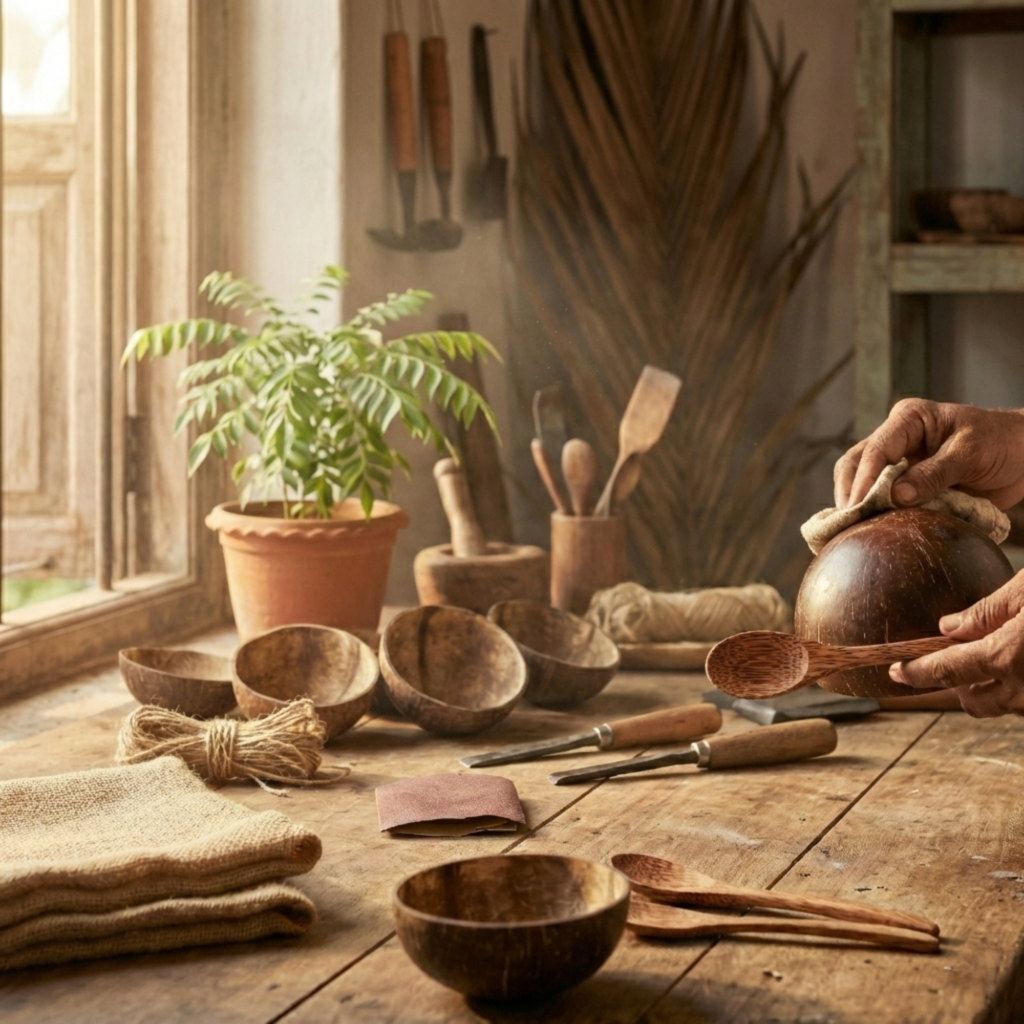
India throws away 36 billion coconut shells every year. We decided to do something different.
Look around your home right now.
The incense holder on your pooja shelf — what’s it made of? The bowl you use for snacks or fruit. The cup you reach for every morning. If you’re like most households in India, the answer is the same for all three: plastic. Factory-made, petroleum-based, destined to outlive you by four centuries.
Now here’s what nobody tells you: it doesn’t have to be this way. Not because of sacrifice. Not because of compromise. But because there’s a material that’s been growing in India’s backyards for thousands of years — one that’s stronger than you think, more beautiful than you expect, and completely, naturally biodegradable.
The coconut shell.
This is the story of why we built Shell & Soul around it — and why, once you understand what this humble material can do, you’ll never look at a plastic bowl the same way again.
The Number That Started Everything
36,000,000,000.
That’s how many coconut shells India discards every year, according to estimates from the coconut processing industry. India is the world’s third-largest coconut producer. We grow coconuts for their water, their flesh, their oil, their milk. And then we throw away the shell — the hardest, most durable part of the entire fruit — like it’s nothing.
Most of those shells get burned. Some decompose slowly in landfills. A small fraction gets turned into activated charcoal or coir fibre. But the vast majority? Wasted.
Meanwhile, we manufacture millions of plastic products every year to fill exactly the roles those shells could play. Bowls. Cups. Holders. Containers. We extract petroleum from the earth, process it into plastic, ship it across the country, use it for a few years — and then watch it sit in a landfill for 450 years, slowly breaking into microplastics that enter our water, our food, and our bodies.
The shell and the plastic. One is a gift from nature, discarded. The other is a debt to the earth, accumulated.
We couldn’t stop thinking about that.
What a Coconut Shell Actually Is
Most of us interact with coconuts without ever thinking about the shell. We crack it, discard it, and move on to the good stuff inside. But the shell deserves more attention than it gets.
The coconut shell — the hard endocarp layer between the husk and the white flesh — is one of nature’s most remarkable materials. It’s dense, smooth, and naturally resistant to moisture. It has a tensile strength comparable to some hardwoods. It doesn’t absorb odours. It’s naturally anti-microbial. And when it’s polished and finished properly, it takes on a warm, rich lustre that no factory can replicate.
In parts of South India, Southeast Asia, and the Pacific Islands, artisans have known this for centuries. Coconut shells have been used to make spoons, bowls, cups, ladles, and decorative items for generations. The craft was passed down through families, refined over decades, and quietly sustained — even as plastic flooded the market and made handcraft seem unnecessary.
It isn’t unnecessary. It’s essential. And it’s making a comeback.
Why Coconut Shell Beats Plastic — In Every Way That Matters
Let’s be direct about this, because the comparison deserves to be made clearly.
On durability: A well-made coconut shell bowl or cup, properly cared for, will last for years. The shell is naturally hard and resistant to cracking under normal use. Plastic, by contrast, scratches easily, fades over time, and leaches chemicals — particularly when exposed to heat.
On food safety: Coconut shell is naturally food-safe. It’s been used to serve and drink from for thousands of years across multiple cultures. When finished with food-safe, chemical-free sealants — as all Shell & Soul products are — it holds liquids cleanly, doesn’t affect taste, and carries no risk of BPA or phthalate contamination that plastic carries.
On beauty: This one isn’t even close. Every coconut shell has a unique grain — dark streaks, natural curves, subtle variations in tone. No two Shell & Soul pieces look exactly alike because no two coconuts are exactly alike. Plastic is identical, interchangeable, and forgettable. A coconut shell cup is a conversation.
On the planet: Plastic takes 450 years to decompose and breaks into microplastics along the way. Coconut shell is fully biodegradable and compostable — it returns to the earth cleanly. The shell is also an upcycled material: it would have been discarded anyway. Using it creates no additional environmental burden.
On what it supports: Every plastic product you buy funds a petrochemical supply chain. Every Shell & Soul product you buy funds a rural artisan in India — someone who has spent years learning a craft, building a skill, and keeping a tradition alive.
There is no category where plastic wins.
The Hands Behind Every Piece
We want to be honest with you about something: Shell & Soul products are not produced at scale. They’re not made by machines in a factory. They take time, because skilled hands take time.
Each piece starts as a raw coconut shell — sourced from local coconut processors who would otherwise discard them. The shell is cleaned, inspected, and passed to an artisan. From there, the process is entirely manual: cutting, shaping, sanding, polishing, and finishing. Depending on the piece, this can take anywhere from one to several hours.
The artisans we work with have been doing this their whole lives. They know how to read a shell — which curves to work with, where the grain is strongest, how to sand without losing the natural texture that makes each piece unique. That knowledge doesn’t come from a manual. It comes from years of quiet, patient practice.
When you hold a Shell & Soul bowl or tea cup, you’re holding the result of that practice. You can feel it in the weight, the smoothness, the slight irregularity that tells you this was made by a human being and not a mould.
That matters. Not just ethically — though it does matter ethically — but experientially. There is a different quality to objects made with intention. They feel different in your hands. They look different on your shelf. They mean something different in your home.
What Shell & Soul Makes — And Why We Chose These Products
We didn’t launch with a hundred products. We launched with five, chosen deliberately.
Coconut Shell Tea Cups — because the morning ritual is sacred. The first cup of tea or coffee you have sets the tone for the day. We wanted that moment to happen in something natural, not synthetic. The shell retains warmth beautifully and the slight natural texture makes it comfortable to hold with both hands.
Coconut Shell Bowls — because the bowl is the most universal vessel in any home. Fruit, snacks, curd, dry prasad, small items on your desk — the bowl goes everywhere. Ours come in four shapes: round, leaf, lotus, and oval. Each shape is a nod to natural forms that coconut shell lends itself to.
Agarbathi and Dhoop Stand — because the pooja space is where intention lives in an Indian home. Burning incense is a daily ritual for millions of households, and yet the holder it rests in is almost always made of plastic or cheap metal. A coconut shell stand brings the pooja corner into alignment with what it represents: something natural, something grounded, something real.
Coconut Shell Wine Goblet — because conscious living shouldn’t mean giving up beauty. The wine goblet with a wooden stem is our most striking piece — it looks extraordinary on a table and tells a story before a word is spoken.
Every product was chosen because it lives in a daily ritual. Not décor that sits on a shelf — objects that are used, touched, experienced every day.
The Simple Care Ritual
One question we get asked often: Is it hard to maintain?
No. But it does require a small shift in habit — the same shift that conscious living asks of us in general. Move gently, with a little more attention.
Hand wash with mild soap and warm water. Dry immediately with a soft cloth — don’t leave it soaking. Occasionally, rub a tiny amount of coconut oil into the surface to keep it nourished. Keep it away from dishwashers, microwaves, and ovens.
That’s it. Five minutes of care, occasionally, for an object that will last for years and biodegrade cleanly when its time comes.
Compare that to plastic: wash it, watch it scratch, watch it fade, throw it away, repeat the cycle endlessly.
This Is a Small Decision With a Larger Logic
We’re not going to tell you that buying a coconut shell bowl will save the planet. It won’t, on its own. The environmental crisis is systemic and will require systemic responses.
But we do believe in the logic of individual choices made at scale. When millions of households each make one small swap — one plastic holder replaced, one synthetic cup set aside — the aggregate effect is real. And more importantly, the internal effect is real: the person who chooses consciously once is more likely to choose consciously again.
The coconut shell is a beginning. A way of saying: I’m paying attention. I’m choosing with intention. I’m bringing that intention into the everyday objects of my home.
That’s what Shell & Soul is built on. Not guilt. Not performance. Just the quiet satisfaction of living with a little less harm.
Start With One Piece
If you’ve read this far, you already know whether this is for you.
You don’t need to replace everything at once. Start with one piece — the one that fits most naturally into a daily ritual you already have. The morning tea cup. The pooja stand. The bowl on your kitchen counter.
Hold it. Use it. Notice how it feels different from what it replaced.
That’s where conscious living actually starts — not in grand gestures, but in the ordinary moments that make up a day.
Browse the Shell & Soul collection at shellandsoul.in
Handcrafted in India. Plastic-free. Ships in 48 hours.
Related reads coming soon:
- 7 Plastic-Free Swaps for Your Pooja Space in 2026
- The Story of Coconut Shell Craft in India — And the Artisans Keeping It Alive
- Is Coconut Shell Food Safe? Everything You Need to Know